
Mr Thabo Nkosi
Offcuts we keep
What happens to the short timber and brass pieces left after every commission.
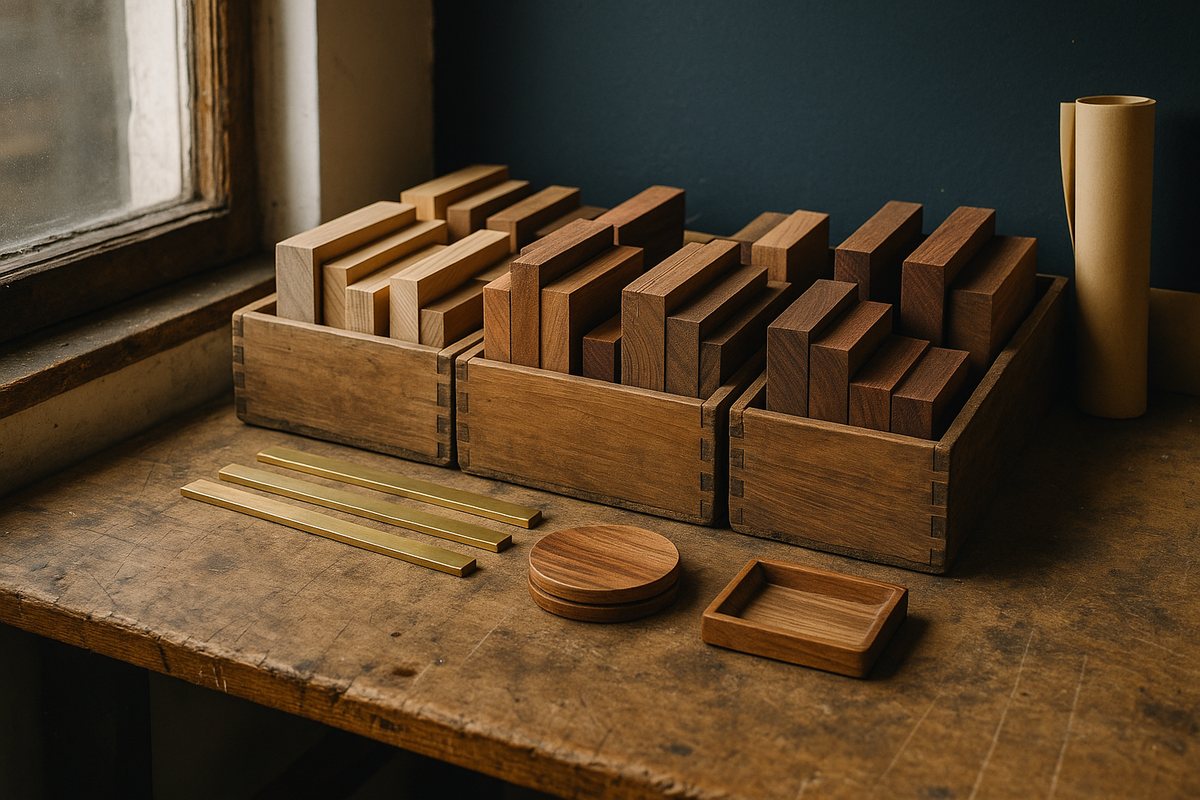
Every commission leaves something behind. A run of Karoo screens might leave a pile of narrow hardwood strips, a batch of edition boxes leaves brass ends no longer than a finger. For years we swept most of it into a bin by the back door and felt slightly guilty about it every Friday. These days the offcut shelf is one of the busiest corners of the Woodstock atelier, and I want to explain how it works and why we bother.
If you came here from the Veld Tray page, a few of those small trays started life on this shelf.
Why we stopped throwing it away
The honest reason is cost. Good hardwood in South Africa is not cheap, and imported brass bar moves with the rand, so a bin full of offcuts at month end is basicly money we paid for and never used. The second reason is quality. Offcuts from a big piece are often the best part of the board, the bit that was too short for a shelf span but has the tightest grain and no knots at all.
There is also a craft reason. When apprentices start, they learn a joint or an inlay on offcuts first, not on a client's board. A mistake on a 200 mm strip costs us nothing, and it means that by the time someone touches a commission for a lodge or an embassy, they have already made the same cut fifty times.
How the shelf is sorted
Nothing works if the offcuts are a heap. We keep shallow crates on a single rack, sorted by species first and length second, and every crate has a handwritten card on the front. Brass lives in a seperate drawer because it scratches timber and because it is the one thing people are tempted to take home.
- Hardwood strips over 300 mm, sorted by species
- Short blocks between 80 mm and 300 mm for small objects
- Birch and marine plywood off-cuts for jigs and templates
- Brass bar and sheet ends, kept in a lined drawer
- Anything shorter than 80 mm goes to the kindling box or the school bins
Once a month somebody spends an hour going through the rack. If a crate has not been touched for three months, it gets cleared out so the shelf never turns into a museum of good intentions.
What the offcuts become
Most of it turns into small things. Coasters and serving boards for the cafe objects work, sample tiles for the finishes library, and test pieces for every new oil or patina we try. When we show a client how muted brass ages next to a particular timber, the sample in there hand was almost always cut from this shelf.
Brass ends become maker marks, little tags and the odd drawer pull. Plywood offcuts become jigs, which is a whole story on its own in Jigs that stay open. And every term a few crates go out to the school maker weeks, where learners make their first box out of timber that would otherwise have been firewood.
What we don't do with them
We dont glue offcuts together and sell them as solid pieces. A tray or a lamp base that is meant to be one board stays one board, and if a client is getting a laminated piece, the quote says so plainly. We also don't charge offcut prices for full commissions. If a client asks for a small object made only from leftovers, we tell them it might not match there main piece exactly and price it lower.
Finally, we don't pretend offcuts are a green miracle. Keeping a shelf tidy uses time and space, and some weeks it feels like alot of effort for a box of coasters. But it keeps the bin smaller and the apprentices sharper, and that is enough for us.
Where to go next
See the Veld Tray and Maker Mark Brass pages for pieces that often use these offcuts. If you'd like a small run of objects from leftover timber for a launch or a gift, email atelier@creationafrica.co.za, or book a sample hour at a showroom and we will bring a crate along.